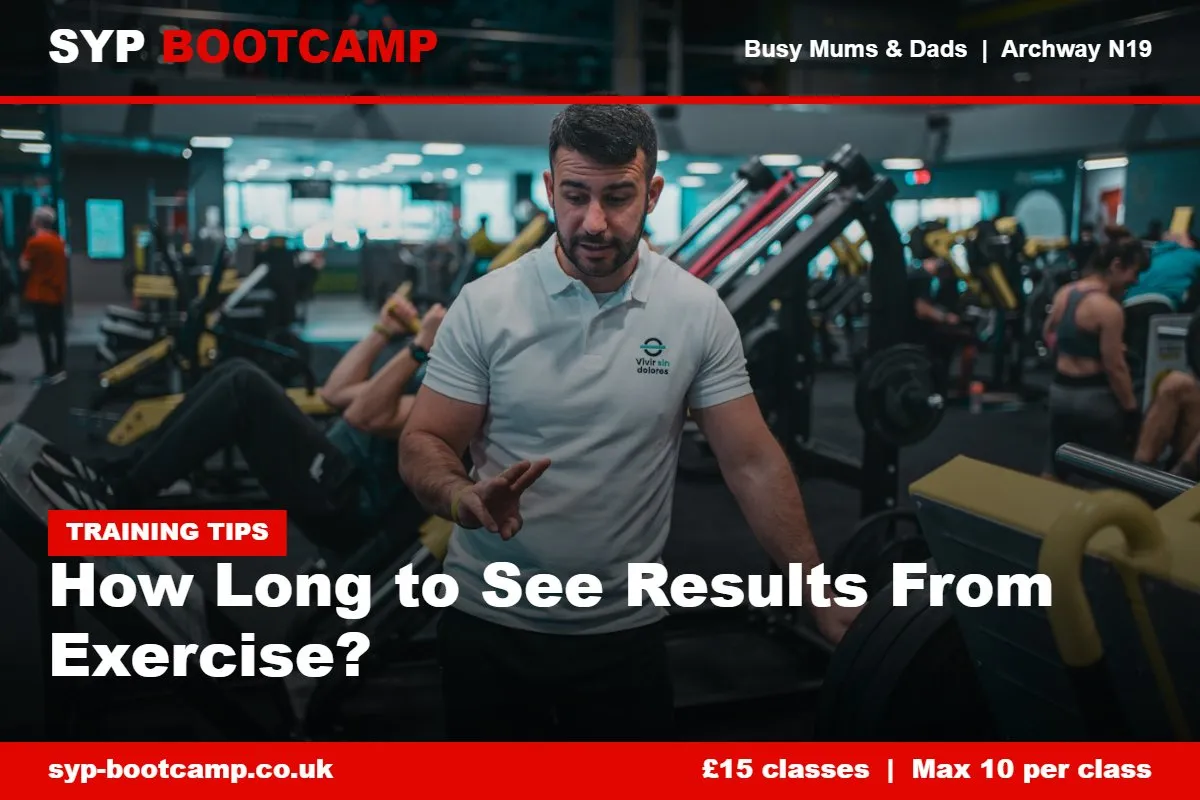
How Long to See Results From Exercise?
You have finally started exercising again. You are squeezing in sessions between work, school pick-ups and bedtime, and you want to know it is going somewhere. So it is natural to ask how long to see results from exercise. I wish I could give you a neat number. Anyone who promises you a specific change by a specific date is guessing. What I can do, after more than 10 years coaching parents in Archway, is explain what usually changes first, what takes longer, and what actually speeds things up or slows them down.
Why there is no single answer
Results from exercise depend on a long list of things, many of which have nothing to do with how hard you try:
- Your starting point and training history.
- How often you can train, and how consistently.
- Your sleep, which for parents of young children can be all over the place.
- Stress at work and at home.
- Your eating habits.
- Age, hormones, health conditions and medication.
- What you mean by “results” in the first place.
That last point matters a lot. “Results” could mean more energy, better sleep, getting stronger, being able to run for a bus, or a change in body shape. These happen on very different timescales.
How long to see results from exercise: what tends to change first
This is the general pattern I see, but please treat it as a rough guide rather than a promise. Everyone is different.
The early changes: how you feel
Many people notice they feel better fairly early on: a bit more energy, a lift in mood, and sometimes better sleep. The NHS notes that physical activity can boost self-esteem, mood, sleep quality and energy. These are the changes most likely to keep you going, so pay attention to them.
Next: strength and fitness
In the first stretch of regular training, a lot of the improvement in strength comes from your body simply getting better at the movements. You learn to squat, hinge and push properly, and the weights start to feel more manageable. Fitness on the stairs and on hills tends to improve too. You will often see this in your workout notes before you see it in the mirror.
Slower: body shape and composition
Visible changes to body shape usually take the longest, and they depend heavily on food, sleep and consistency over months. They are also the hardest to judge day to day, which is why I recommend a few different ways of measuring. My guide on how to track progress without scales walks you through them.
The long game: health
Some of the biggest benefits are ones you cannot see at all. The NHS says regular exercise can lower your risk of major illnesses including coronary heart disease, stroke and type 2 diabetes. That is built over years, not weeks.
What actually helps you see progress sooner
- Be consistent before you are intense. Two sessions a week every week beats five sessions one week and none the next. The NHS guidelines for adults suggest strength work on at least 2 days a week and spreading activity across the week.
- Get gradually harder. Add a rep, a little weight or a bit more control over time. If every session is the same, your body has no reason to change.
- Protect your recovery. Sleep and rest days are when the work pays off. Read more in my post on rest days and recovery.
- Sort the basics of food. Regular meals with protein and vegetables make a bigger difference to body shape than any single workout.
- Write things down. A note on your phone with your weights, reps and how you felt shows you progress that is easy to miss.
What slows progress down
- Stopping and starting. Every restart costs you a few weeks.
- Going too hard too soon. Being wiped out or injured after week one is the fastest way to stall.
- Chasing a quick fix. Extreme diets and punishing plans rarely last, especially with a family to look after.
- Comparing yourself to others. Someone else’s timeline tells you nothing about yours.
Where a small-group bootcamp fits
The thing that most affects how long it takes is usually consistency, and that is where a booked class helps. You have a set time, a coach expecting you and a small group of other parents in the same boat. At SYP Bootcamp classes have a maximum of 10 people and last 45 minutes, so I can make sure you are progressing sensibly rather than just getting tired. See this week’s class times on the booking page.
FAQs
Why am I not seeing results from working out?
The most common reasons are inconsistent training, sessions that never get harder, poor sleep and eating habits that do not match the goal. It is also possible you are making progress but only looking at one measure, such as the scales.
Do you see results faster as a beginner?
Beginners often notice improvements in strength and fitness quite quickly because everything is new to the body. How much and how fast still varies a lot from person to person.
How many times a week should I exercise to see results?
For most busy parents, two or three structured sessions a week plus plenty of walking is a realistic, effective starting point. The NHS recommends strength activities on at least 2 days a week alongside your weekly activity target.
Start building consistency this week
If you want a regular, coached session that you can actually stick to, come and try SYP Bootcamp. Classes are £15, indoors in Archway, N19, and suitable for all fitness levels. Go to the SYP Bootcamp booking page and tap “Book my £15 class”, or WhatsApp me on 07301 512215. If you would like a structured plan with regular check-ins over a set period, you can read about the 12-week body transformation programme at SYP Fitness.
About the author
Artem Olekhnovych is a personal trainer in Archway and the founder of SYP Fitness and SYP Bootcamp. He has coached clients in Archway, Highgate and across North London for over 10 years, and runs small-group bootcamp classes for busy mums and dads. Read reviews from his 1-1 clients.
