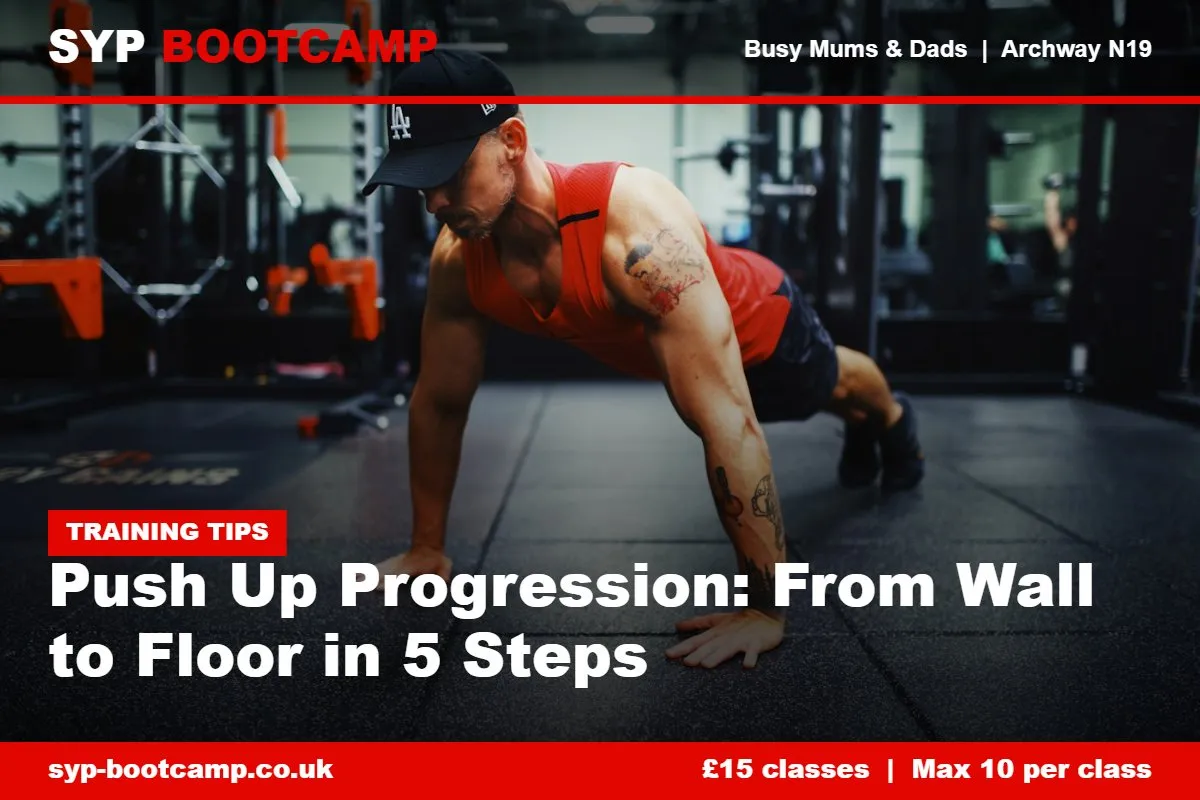
Push Up Progression: From Wall to Floor in 5 Steps
If you cannot do a single push-up from the floor right now, you are in very good company. Most mums and dads who come to my classes in Archway say the same thing on day one. The good news is that you do not need to force it. A simple push up progression takes you from the wall to the floor one small step at a time, building strength in your chest, shoulders, arms and core along the way. Here is the exact ladder I use, with step-by-step cues for each level.
Why push-ups are worth the effort
A push-up is a bodyweight exercise you can do anywhere, in the kitchen while the pasta boils if needed. It works your chest, shoulders and the backs of your arms, and your tummy and bum have to work to hold you in a straight line. The NHS lists bodyweight exercises such as push-ups as an example of muscle-strengthening activity in its physical activity guidelines for adults, which recommend strength work on at least 2 days a week.
If you have shoulder or wrist pain, are pregnant, or have recently had a baby (especially if you have tummy separation), check with your GP or physio first. Wall and worktop push-ups are often a gentler place to begin.
The 5-step push up progression
Stay on each level until you can do 3 sets of 10 good reps, then move on. Good reps beat lots of reps.
Level 1: Wall push-up
- Stand about an arm’s length from a wall.
- Place your hands on the wall at shoulder height, a little wider than your shoulders.
- Step your feet back slightly so you lean in, body in a straight line from head to heels.
- Bend your elbows, pointing them back at roughly 45 degrees (not straight out to the sides), and bring your chest towards the wall.
- Push the wall away until your arms are straight.
Level 2: Worktop or table push-up
- Place your hands on the edge of a sturdy kitchen worktop or heavy table.
- Walk your feet back until your body forms a straight line.
- Gently squeeze your bum and brace your tummy.
- Lower your chest to the edge with control, elbows at about 45 degrees.
- Push back up, keeping your hips in line with your shoulders.
Level 3: Low incline push-up
- Use a lower, stable surface such as a sturdy step, bench or the bottom of the stairs.
- Set up in the same straight-line position.
- Lower slowly for a count of 2.
- Pause just above the surface.
- Press up and breathe out.
Level 4: Knee push-up
- Kneel on a mat, hands on the floor slightly wider than your shoulders.
- Walk your hands forward until your body is in a straight line from head to knees (not bum in the air).
- Brace your tummy and lower your chest towards the floor.
- Keep your elbows at about 45 degrees.
- Push the floor away to return to the start.
Level 5: Full push-up
- Start in a high plank: hands under shoulders, legs straight, toes tucked under.
- Squeeze your bum and brace your tummy so your body is like a plank of wood.
- Lower your chest towards the floor with control.
- Go as low as you can while keeping that straight line.
- Push back up in one piece, hips and shoulders rising together.
Harder options once you have full push-ups
- Slow lowering: 3 to 4 seconds down, normal speed up.
- Pause push-ups: hold for 2 seconds just above the floor.
- Feet raised: put your feet on a low step to shift more weight onto your arms.
Common mistakes to watch for
- Sagging hips: squeeze your bum and brace harder, or go back a level.
- Elbows flared straight out: tuck them in to about 45 degrees. This is usually more comfortable for the shoulders.
- Head dropping: keep your eyes on the floor slightly in front of your hands.
- Tiny reps: a shorter, honest range on an easier level is better than half reps on the floor.
A weekly plan you can follow
- Pick the level where you can do 6 to 10 good reps.
- Do 3 sets, resting about a minute between sets.
- Train push-ups 2 or 3 times a week, with a day off in between.
- Add a rep or two each session.
- When you reach 3 sets of 10, move to the next level and start again at 6 to 8 reps.
Push-ups pair nicely with core work, which I cover in core exercises for beginners. If you want to fit them into a quick session, try my no-equipment home workout.
Where a small-group class fits
In SYP Bootcamp in Archway everyone does push-ups at their own level, side by side. Some people are on the wall, some on their knees, some on the floor. There are never more than 10 people, so I can tell you when you are ready to move up. Sessions are 45 minutes and £15. See this week’s class times on the booking page.
FAQs
How long does it take to do a full push-up?
It varies a lot from person to person, depending on your starting strength and how often you practise. Working through the levels 2 or 3 times a week is the most reliable way to get there.
Are knee push-ups a waste of time?
No. Knee push-ups train the same muscles with less load. Done with a straight line from head to knees, they are a great step towards full push-ups.
Why do my wrists hurt during push-ups?
Wrists can feel it if you are not used to taking weight through your hands. Try an incline level, spread your fingers wide, or hold dumbbell handles to keep your wrists straight. If pain persists, check with your GP or physio.
Want someone to coach you through the levels? Book my £15 class or WhatsApp 07301 512215. And if you would like a 1-1 plan built just for you, see personal training for women in Archway.
About the author
Artem Olekhnovych is a personal trainer in Archway and the founder of SYP Fitness and SYP Bootcamp. He has coached clients in Archway, Highgate and across North London for over 10 years, and runs small-group bootcamp classes for busy mums and dads. Read reviews from his 1-1 clients.
