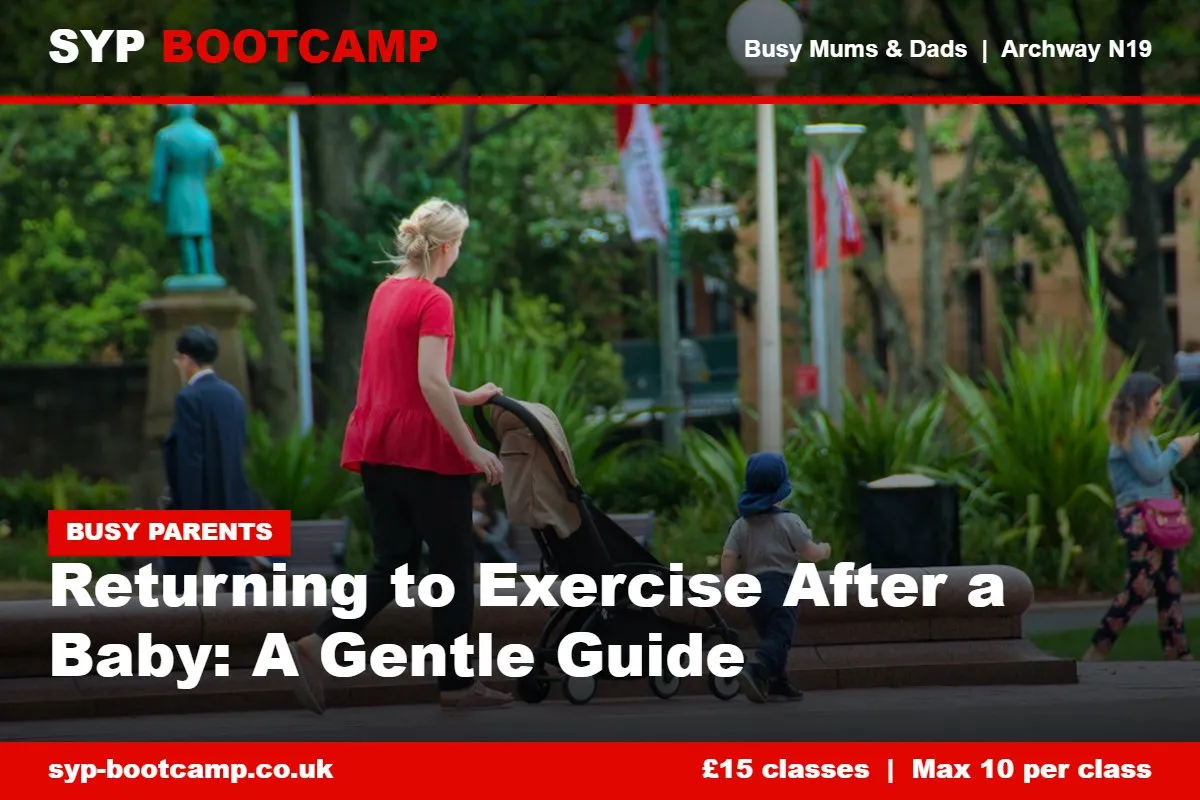
Returning to Exercise After a Baby: A Gentle Guide
You are running on broken sleep, your body feels like it belongs to someone else, and everyone online seems to be “bouncing back” in a fortnight. If you are thinking about returning to exercise after a baby, I want to start by taking some pressure off. There is no race. The goal is to feel stronger and more like yourself, at a pace your body agrees with.
I am Artem, a personal trainer in Archway for over 10 years. I am not a physio, midwife or doctor, so this post is general guidance, not a medical or rehab plan. Please check with your GP, midwife or health visitor before you start, and ask for a women’s health physio referral if anything feels wrong.
What the NHS says about returning to exercise after a baby
The NHS page on keeping fit and healthy with a baby is the best starting point. In short:
- After a straightforward birth, you can start gentle exercise, such as walking, gentle stretches and pelvic floor exercises, as soon as you feel up to it.
- It is usually best to get advice at your 6-week postnatal check before you start high-impact exercise like aerobics or running.
- After a caesarean or a complicated delivery, recovery takes longer, so talk to your midwife, health visitor or GP before doing anything strenuous.
- Your ligaments and joints can stay more flexible for a few months after birth, so be careful with deep stretches and twisting.
- If you want to swim, the NHS says to wait until 7 days after postnatal bleeding has stopped.
That is the framework. Everything below sits inside it.
Five practical steps for the first few months
1. Start with walking
Walking is underrated. A brisk walk with the buggy gets you outside, lifts your mood and builds a base of fitness without any jumping. The NHS suggests keeping your arms bent and back straight when you push, with the handles set so your elbows sit at roughly a right angle. Start with what feels easy and add a few minutes when that feels comfortable.
2. Make pelvic floor exercises a daily habit
Pelvic floor exercises are on the NHS list of gentle things you can start early. The NHS post-pregnancy body page explains how to do them and suggests building up to 10 repeats of each exercise, at least three times a day. I go into more detail in my post on pelvic floor and exercise classes.
3. Respect your tummy muscles
It is common for the two long muscles down the middle of your tummy to separate in pregnancy. The NHS says this usually returns to normal by the time your baby is 8 weeks old, and advises avoiding sit-ups, planks and high-impact exercise at first. If the gap is still obvious at 8 weeks, contact your GP. So for now, skip the crunches you see on social media.
4. Sort out your kit
Small thing, big difference. The NHS recommends getting measured for a new sports bra, because your back and cup size may have changed, and even checking your shoe size, as feet can change shape in pregnancy. Comfortable kit makes it far easier to actually go.
5. Lift your baby like a lifter
You already do dozens of lifts a day: car seat, cot, buggy, shopping. Bend your knees rather than your waist, and hold heavy things close to your body. This is everyday strength training, and practising good habits now protects your back later.
Signs to slow down and get checked
Your body gives you feedback. Stop and speak to your GP or health visitor if you notice:
- Leaking urine when you cough, laugh, jump or lift
- A heavy or dragging feeling between your legs
- Pain in your tummy, pelvis, back or around a scar
- Bleeding that gets heavier after activity
- A visible doming or bulge down the middle of your tummy when you move
None of these mean you did something “wrong”. They are signals that you need a proper assessment, and a GP can refer you to a physio if needed.
Your head matters too. The NHS says baby blues usually pass within about 2 weeks of the birth, and that if low mood carries on or gets worse you should speak to your GP, midwife or health visitor. Their postnatal depression page lists the signs and suggests things like a short daily walk alongside proper support.
Where a small-group bootcamp fits
Once you have had your postnatal check and been told you are fine to build up, a small, friendly class can be a good next step. At SYP Bootcamp in Archway, classes are capped at 10 people, so I know who is in front of me. Tell me at the start that you have had a baby recently and whether it was a caesarean, and I will give you lower-impact options for anything that does not feel right, like step-backs instead of jumps.
Classes are 45 minutes and £15, which suits people who need to be home before the next feed. You can see this week’s class times on the booking page. If you had a caesarean, read my post on exercise after a c-section first.
FAQs
How soon after having a baby can I exercise?
The NHS says gentle exercise like walking, stretches and pelvic floor exercises can start as soon as you feel up to it after a straightforward birth. Get advice at your 6-week check before high-impact exercise. After a caesarean or complicated birth, speak to your midwife, health visitor or GP first.
Can I go to a fitness class 6 weeks after giving birth?
Possibly, but only after your postnatal check and with the instructor knowing you are postnatal. Many people need longer than 6 weeks before they are ready for jumping or heavy lifting. A good class should give you lower-impact options without fuss.
Is it normal to leak when I exercise after a baby?
It is common, but it is not something you just have to live with. Speak to your GP, who can refer you for specialist help such as a women’s health physio.
Ready when you are
When you have the all-clear and you fancy 45 minutes that is just for you, come and try a class. No pressure, no shouting, and every exercise has an easier version. Book my £15 class, or message me on WhatsApp on 07301 512215 if you want to ask a question first. If you would rather start with one-to-one support built around your recovery, have a look at personal training for women in Archway.
About the author
Artem Olekhnovych is a personal trainer in Archway and the founder of SYP Fitness and SYP Bootcamp. He has coached clients in Archway, Highgate and across North London for over 10 years, and runs small-group bootcamp classes for busy mums and dads. Read reviews from his 1-1 clients.
