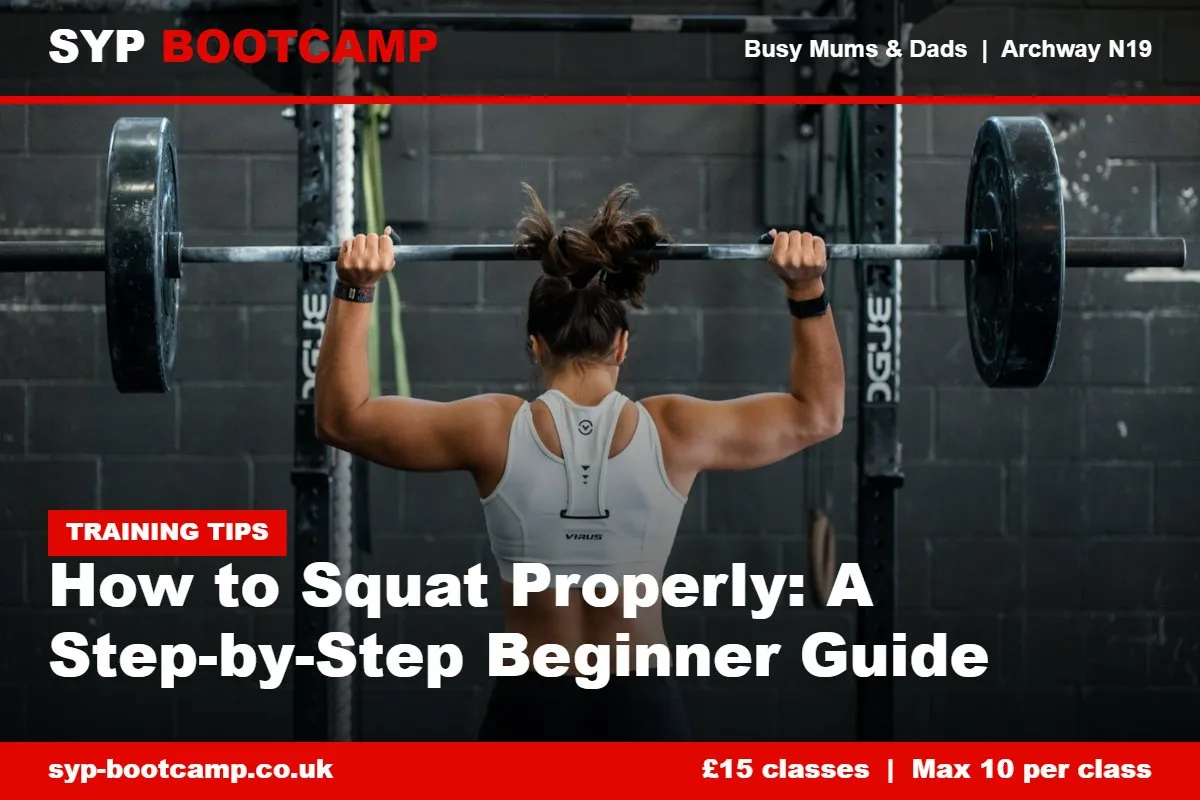
How to Squat Properly: A Step-by-Step Beginner Guide
You squat dozens of times a day without thinking about it. Picking up a toddler, loading the washing machine, getting off the sofa after bedtime. That is exactly why learning how to squat properly is one of the most useful things a parent can do. A good squat makes daily life easier and is the foundation for almost every lower-body exercise. Here is the step-by-step method I teach beginners in Archway, plus the most common mistakes and how to fix them.
Why the squat matters so much
The squat works your thighs, bum and hips, and your core has to work to keep you steady. The NHS physical activity guidelines for adults recommend strengthening activities that work all the major muscle groups on at least 2 days a week, and legs and hips are two of the groups they list. A squat covers both with no equipment at all.
If you have knee, hip or back pain, are pregnant or recently postnatal, check with your GP or physio before adding squats to your routine.
How to squat properly: step by step
- Set your feet. Stand with your feet about hip to shoulder width apart, toes turned out a little (around the angle of 11 and 1 on a clock). Find what feels comfortable for your hips.
- Spread your weight. Feel your weight across the whole foot: big toe, little toe and heel.
- Brace. Take a breath in and gently tighten your tummy, as if someone was about to poke you.
- Start the movement. Bend at your hips and knees at the same time, as if sitting back onto a low chair.
- Track your knees. Let your knees travel in the same direction as your toes. It is fine for them to move forward over your toes if your heels stay down.
- Keep your chest proud. Your body will lean forward a little. That is normal. Just do not let your back round.
- Find your depth. Go as low as you can while your heels stay on the floor and your back stays neutral. For many people that is thighs around parallel to the floor, for some it is higher. That is fine.
- Stand up. Push the floor away through your whole foot, squeeze your bum at the top and breathe out.
Common squat mistakes and quick fixes
- Heels lifting: widen your stance slightly, turn your toes out a bit more, or squat to a higher box until your ankles loosen up.
- Knees caving in: think “spread the floor apart” with your feet, and push your knees gently out in line with your toes.
- Back rounding at the bottom: you are going deeper than your hips allow right now. Stop a little higher.
- Dropping fast: slow the lowering phase to a count of 2 or 3. Control is where a lot of the benefit is.
- Holding your breath the whole time: breathe in on the way down, out on the way up.
Easier and harder squat options
Start where you are, not where you think you should be.
Easier
- Supported squat: hold onto a kitchen worktop or door frame for balance.
- Box squat: squat to a sturdy chair, touch the seat lightly, then stand. Use a higher surface to make it easier still.
- Quarter squat: only bend part of the way down while you build strength and confidence.
Harder
- Tempo squat: 3 seconds down, 1 second pause, stand up.
- Goblet squat: hold a kettlebell, dumbbell or a full backpack at your chest. My guide to kettlebell exercises for beginners walks through this.
- Split squat: one foot forward, one back, lower your back knee towards the floor. Great for balance and working each leg on its own.
A simple squat plan for this week
- Warm up for 5 minutes. My post on how to warm up before exercise has a quick routine.
- Do 3 sets of 8 to 10 reps of the version that lets you keep good form.
- Rest about a minute between sets.
- Repeat 2 or 3 times this week, with a day off in between.
- When all 3 sets feel comfortable, move to the next version up.
If squats bother your knees, try a higher box, a shorter range, or swap to glute bridges for the day. Sharp pain is a sign to stop and get it checked by a GP or physio.
Where a small-group class helps
Most people cannot see their own squat. Their knees cave or heels lift and they have no idea. In SYP Bootcamp classes in Archway there are never more than 10 people, so I can watch each person squat, pick the right version and give one simple cue to fix it. Sessions are 45 minutes and £15, suitable for every level. See this week’s class times on the booking page.
FAQs
Should my knees go past my toes when I squat?
For most people, a bit of forward knee travel is normal and needed to squat deeply, as long as your heels stay down and the movement is comfortable. If it causes knee pain, shorten the range and get it checked.
How low should I squat?
As low as you can while keeping your heels down and your back neutral. Depth varies with hip shape and ankle mobility. A controlled half squat is better than a sloppy deep one.
How many squats should a beginner do?
Start with 2 to 3 sets of 8 to 10 reps, two or three times a week. Add reps or move to a harder version when that feels comfortable.
Want someone to check your squat in person? Book my £15 class or WhatsApp me on 07301 512215. If you are working around an old injury and want 1-1 support, see my injury-safe personal training.
About the author
Artem Olekhnovych is a personal trainer in Archway and the founder of SYP Fitness and SYP Bootcamp. He has coached clients in Archway, Highgate and across North London for over 10 years, and runs small-group bootcamp classes for busy mums and dads. Read reviews from his 1-1 clients.
