Knee Friendly Workouts for Busy Parents
Lots of parents tell me they’d love to get fit, but their knees aren’t keen. Jumping makes them ache, deep squats feel wrong, and running for the bus is a gamble. The good news is you don’t have to choose between your knees and getting stronger. Knee friendly workouts are about choosing and adjusting exercises so you can still train hard, just in a way that suits you.
I’ve coached clients in Archway for over 10 years, and some of my most consistent people are the ones who had to work around their knees. Here’s how I’d approach it.
Get your knee checked first
I’m a trainer, not a doctor or physio, and I can’t tell you what’s going on with your knee. If you have knee pain, see your GP or a physiotherapist before starting a new programme. The NHS knee pain page says to see a GP if pain hasn’t improved within a few weeks, and to get urgent advice from 111 if your knee is very painful, you can’t put weight on it, it’s badly swollen or changed shape, it locks or gives way, or you have signs of infection such as a high temperature with a red, hot knee. It also notes that in many areas you can get NHS physiotherapy through community MSK services without a GP referral.
Once you’ve been checked and given the go-ahead, the ideas below are a general starting point. Follow any specific advice from your health professional over anything here.
What makes a workout knee friendly?
In my experience, these principles help most people who are cautious about their knees:
- Low impact first: swap jumping for stepping. You can still get your heart rate up.
- Control the range: work in a depth that feels comfortable, and build it gradually.
- Slow it down: slower, controlled reps put you in charge of the movement.
- Strengthen the whole leg: hips, glutes, thighs and calves all share the work.
- Use the pain rule: if something causes sharp pain or makes your knee feel worse afterwards, stop and ask your physio.
Knee friendly workouts: a 30-minute session
Here’s a sample session you can do at home with a chair, a step and a resistance band. Warm up first with 5 minutes of marching on the spot and gentle leg swings. My warm-up guide has more ideas.
Part 1: strength (2 to 3 rounds)
- Box squat to a chair, 10 reps: sit back to touch the seat, then stand. Use a higher chair or cushion if you need less depth.
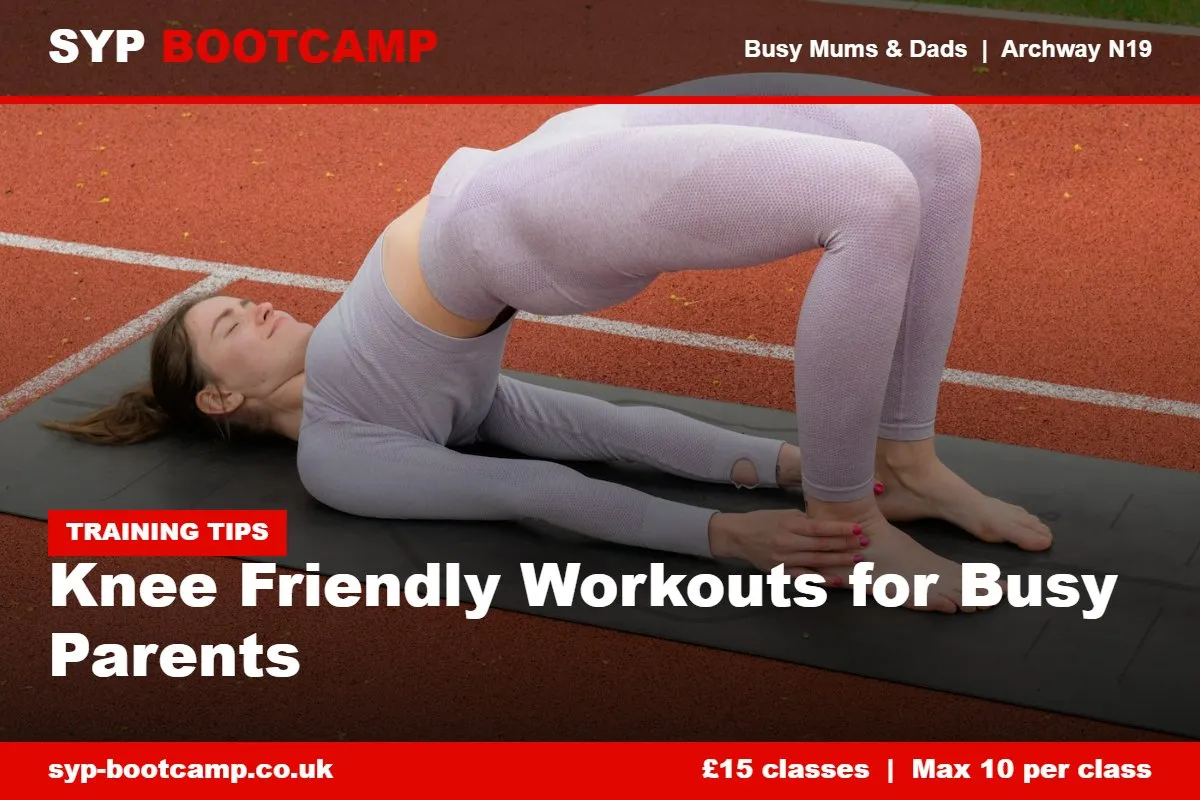
- Glute bridge, 12 reps: builds your hips with very little load through the knee.
- Step-up on the bottom stair, 8 each leg: hold the banister, push through the whole foot.
- Banded side steps, 10 each way: band round your thighs, small steps sideways.
- Standing calf raises, 15 reps: hold a wall for balance.
Part 2: low impact conditioning (8 minutes)
40 seconds on, 20 seconds rest, rotating through:
- Fast marching on the spot
- Standing punches with a soft knee
- Step jacks (step one foot out at a time instead of jumping)
- Mountain climbers with hands on the sofa, stepping rather than running
Part 3: upper body and core (2 rounds)
- Push-ups against the kitchen counter, 10 reps
- Band rows, 12 reps
- Dead bugs, 8 each side
Easy swaps for common exercises
If you’re in a class or following a video, these swaps are worth knowing:
- Jump squats become box squats or squats with a calf raise
- Lunges become split squats holding a chair, or step-ups
- Burpees become step-back burpees with hands on a bench
- Skipping becomes fast marching or a cross-trainer
- Running becomes brisk walking, cycling or swimming
For broader advice on training with sore joints, read my post on exercising with joint pain.
Building up over the weeks
Start with what your knee tolerates comfortably and progress slowly. Add a rep or two, a little more depth, or a slightly heavier weight, one change at a time. Aim to build towards the NHS guidelines of 150 minutes of moderate activity a week and strength work on at least 2 days. Brisk walking, cycling and swimming are all listed by the NHS as moderate activities, which gives you plenty of low impact options.
Where a small-group bootcamp fits
A common worry is: “Will I be the one who can’t do the jumps?” At SYP Bootcamp, no. Every exercise has a low impact option, and with a maximum of 10 people I can help you choose the right version without making a thing of it. Please let me know about your knee and what your GP or physio has said before your first session.
Classes are 45 minutes, indoors in Archway, £15 each. You can see this week’s class times on the SYP Bootcamp booking page.
FAQs
What exercises are good for bad knees?
Many people with sensitive knees get on well with low impact options like cycling, swimming, brisk walking, glute bridges and box squats. The right choice depends on the cause, so ask your GP or physio.
Should I avoid squats if my knees hurt?
Not necessarily. Squatting to a chair or a comfortable depth is often a useful starting point, but get your knee assessed first and follow your physio’s advice.
Can I do a bootcamp class with bad knees?
Often yes, if your health professional is happy and the coach offers low impact options. Tell the coach about your knee before you start.
Train without fearing your knees
Once you’ve had your knee checked, come and try a session with low impact options throughout. Book my £15 class, or WhatsApp me on 07301 512215 first. If you’d like a plan built around your physio’s advice, take a look at injury-safe 1-1 training with SYP Fitness.
About the author
Artem Olekhnovych is a personal trainer in Archway and the founder of SYP Fitness and SYP Bootcamp. He has coached clients in Archway, Highgate and across North London for over 10 years, and runs small-group bootcamp classes for busy mums and dads. Read reviews from his 1-1 clients.
